
What Should You Do First When a Pipe Bursts in Cedar Valley, UT?
Shut off your home's main water supply valve immediately, switch off electrical breakers supplying any wet rooms, and open lower-level cold faucets to relieve residual line pressure. Taking those three steps inside the first five minutes prevents hundreds of gallons of pressurized water from saturating framing, insulation, and finished basements before an independent burst pipe water damage crew arrives.
Across western Utah County—from wind-swept acreage in Cedar Fort and Fairfield to multi-story subdivisions in Eagle Mountain and The Ranches—high-altitude winter inversions regularly drop overnight lows into single digits. Even a hairline 1/8-inch split in a half-inch copper or PEX supply pipe operating at standard 55 to 65 PSI household pressure can discharge roughly 4 to 8 gallons every single minute. That means a twenty-minute delay while hunting for a wrench can easily dump more than 100 gallons into your subfloor and ceiling cavities.
Minute-by-Minute Emergency Action Plan (Minutes 0 to 60)
Follow a strict safety-first sequence during the first hour: stop the water source, eliminate electrical shock hazards, document the active damage for insurance, and protect salvageable contents. Avoid grabbing a mop or running household fans before water and power are isolated, because rushing into standing water near energized baseboards creates serious shock risk.
| Time Window | Priority Action | Why It Matters in Cedar Valley Homes |
|---|---|---|
| Minutes 0–5 | Close the main interior shutoff valve (or curbside meter box if interior valve is frozen or stuck). | Stops pressurized flow immediately; older 84013 gate valves should be turned gently to avoid snapping corroded stems. |
| Minutes 5–10 | Turn off circuit breakers for affected rooms and shut down gas/electric water heaters if lower mechanical rooms are wet. | Prevents electrical arcing in basement wall outlets and stops tank water heaters from dry-firing after supply is cut. |
| Minutes 10–15 | Open the lowest cold-water tap (basement utility sink or exterior frost-free bib if above freezing) and flush toilets once. | Drains residual gravity water out of upper-story risers so ceilings stop dripping as quickly as possible. |
| Minutes 15–25 | Call a licensed plumber for pipe repair and our 24/7 Cedar Valley water damage restoration line for mitigation dispatch. | Utah County restoration crews stage truck-mounted extractors while the plumber isolates and repairs the broken fitting. |
| Minutes 25–45 | Take wide-angle and close-up photos/videos of the burst pipe, standing water depth, and wet baseboards before moving items. | Establishes sudden-and-accidental proof required by Utah homeowners insurance adjusters. |
| Minutes 45–60 | Elevate wood furniture legs on aluminum foil or plastic blocks, lift draperies off wet carpet, and clear a path for extraction hoses. | Stops dark furniture stain transfer onto wet carpet and lets technicians start pumping the moment they arrive. |
Where Is the Main Water Shutoff Valve in Most Cedar Valley Homes?
In most Utah County single-family homes, the main shutoff valve sits in the basement utility room or garage along the street-facing foundation wall where the main supply enters from underground. Rural homes in Cedar Fort and Fairfield on private wells instead locate the primary shutoff beside the pressure tank and electrical well-pump breaker.
Before winter arrives, every adult in the household should know the exact valve type installed on your main line. Newer homes built after 2005 in SilverLake and Eagle Mountain almost always use a quarter-turn brass ball valve with a flat lever handle; turning the lever 90 degrees perpendicular to the pipe shuts water off instantly. Older ranch homes built before 1995 in Cedar Fort, Fairfield, or established parts of Saratoga Springs frequently still have multi-turn wheel-style gate valves. Because Utah County water is naturally hard with high calcium and magnesium content, mineral scale often stiffens gate-valve packing nuts—if a wheel valve refuses to budge, do not force it with a pipe wrench, which can shear the stem. Instead, shut water off at the municipal meter pit near the street using a curb key, or flip the dedicated well-pump breaker on rural 84013 parcels.
Why Do Pipes Usually Burst During a Thaw Instead of the Coldest Night?
Water expands by roughly 9 percent when it freezes into ice, creating hydraulic pressure spikes inside the pipe between the ice blockage and a closed faucet. The pipe wall actually splits during the deep freeze, yet solid ice temporarily plugs the crack until daytime temperatures rise above 32°F and thaw the blockage.
That delayed thaw explains why so many homeowners across Cedar Valley wake up to a dry utility room on a 10°F morning, leave for work along SR-73, and return home at 4:00 p.m. to water pouring through a finished basement ceiling. The most vulnerable zones in local architecture include:
- Exterior Hose Bibs Left Connected to Garden Hoses: Even frost-free sillcocks split inside the heated rim-joist cavity if a connected garden hose traps water inside the stem during October or November freezes.
- Uninsulated Crawl Spaces and Rim Joists: Older 84013 homes with vented crawl spaces allow freezing canyon winds to strike exposed copper lines directly beneath kitchen and bathroom floors, often leading to urgent crawl space water removal.
- Plumbing on North-Facing Exterior Garage Walls: Attached garages in Eagle Mountain and Saratoga Springs frequently drop below freezing when overhead garage doors open repeatedly, freezing supply lines feeding laundry rooms or upstairs master baths directly above.
- Unheated Attic Fire-Sprinkler or Recirculation Lines: Gaps in blown-in fiberglass insulation allow sub-freezing attic air to reach PEX elbows and brass tees.
How Should You Handle a Sagging Wet Ceiling Without Causing a Collapse?
Never stand directly beneath a bulging or bowed sheetrock ceiling, because trapped water and wet fiberglass insulation can weigh hundreds of pounds and drop without warning. Place a large trash bin or plastic tub directly under the lowest point, stay to the side, and wait for a trained mitigation technician—or only if water is rapidly spreading toward electrical fixtures, cautiously poke a single small relief hole near the edge of the blister with a long screwdriver while wearing eye protection.
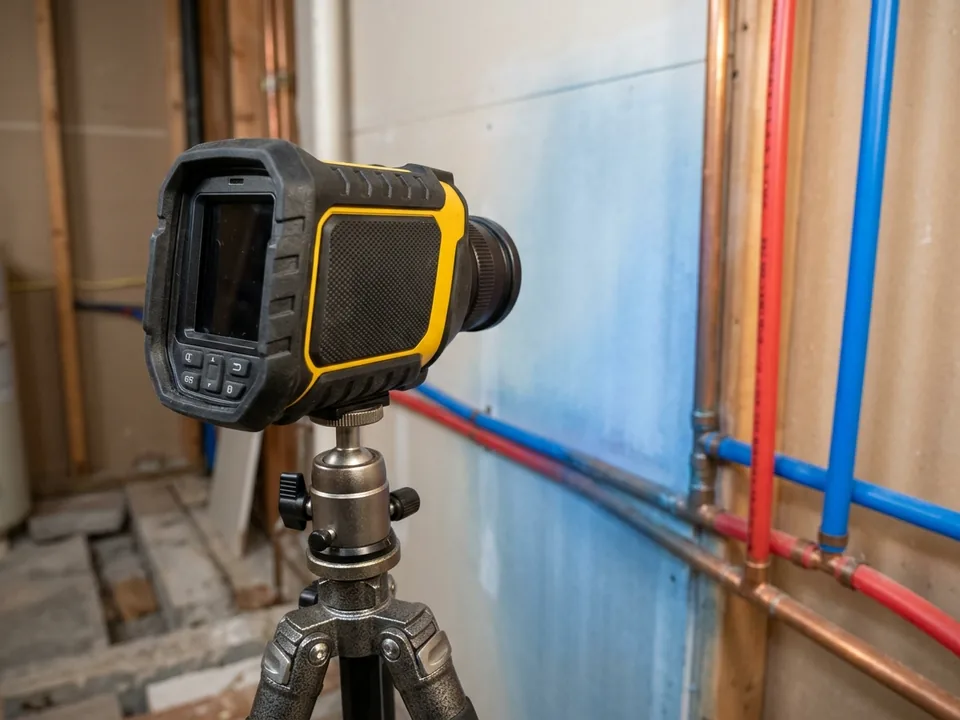
Wet gypsum drywall loses nearly all of its screw-holding tensile strength once saturated. When water runs along ceiling joists from an upstairs burst pipe, it follows the path of least resistance—often pooling right on top of recessed LED can lights, HVAC supply boots, or taped seam joints ten feet away from the actual pipe rupture. Independent restoration crews use infrared thermal cameras to map the full ceiling footprint before setting up containment plastic and performing emergency water extraction below.
Why Household Box Fans and Wet-Dry Shop Vacs Fall Short After a Pipe Burst
A standard household shop vacuum removes surface puddles on bare tile, but it cannot extract water trapped inside dense carpet cushion, subfloor tongue-and-groove joints, or insulated wall cavities. Worse, pointing portable box fans at wet walls without commercial dehumidification pushes evaporated moisture into dry upstairs closets and bedrooms, causing secondary condensation and swollen doors.
Under ANSI/IICRC S500 water mitigation principles, safe drying requires balancing evaporation (high-velocity air movement) with moisture capture (Low-Grain Refrigerant dehumidifiers). When a burst pipe floods a finished lower level, an independent basement flood cleanup crew pulls saturated carpet pad, detaches baseboards, inspects bottom plates with pin moisture meters, and stages structural drying equipment so hidden framing dries inside 3 to 5 days rather than festering behind paint for weeks.
Local Permitting & Plumbing Code Basics in Utah County
Emergency water extraction and structural drying generally do not require a municipal building permit, whereas replacing significant sections of pressurized plumbing, electrical circuits, or structural framing during reconstruction may require permits through Utah County or your local city building department.
In unincorporated Utah County areas and smaller towns like Cedar Fort and Fairfield, homeowners should confirm with their licensed plumber or general contractor whether a plumbing permit and pressure inspection are required when repiping freeze-damaged runs or replacing a ruptured water heater. Eagle Mountain and Saratoga Springs maintain their own municipal building departments enforcing adopted International Residential Code (IRC) and Utah state plumbing amendments—including frost-depth burial standards (typically 24 to 36 inches in Utah County), expansion tanks on closed water-heater systems, and proper insulation of piping in exterior walls. Keeping your mitigation phase cleanly separated from permitted rebuild work also simplifies your paperwork when you review our Utah homeowners insurance claim checklist.
Pre-Call Diagnostic Checklist Before Restoration Crews Arrive
Spending five minutes organizing key facts about your water loss helps the dispatched restoration technician bring the right pumps, floor mats, and containment gear on the first truck.
- Confirm Source Status: Is the main valve closed and dripping completely stopped, or is water still entering from an active leak?
- Identify Water Type: Did the leak come from a clean cold/hot supply line (Category 1), a washing machine drain (Category 2), or a sewer/septic line (Category 3)?
- List Affected Floor Surfaces: Note whether water touched solid hardwood, engineered wood, floating LVP, tile, concrete, or carpeted rooms with padding.
- Check Below the Leak: Always inspect the basement ceiling or crawl space directly beneath a main-floor burst pipe—gravity almost always carries water downward.
- Estimate Ballpark Scope: If you want a rough idea of Utah mitigation costs before the crew evaluates the property, try our Cedar Valley water damage cost calculator.
Frequently Asked Questions
Should I turn off my water heater after shutting off the main water valve?
Yes. If you shut off the main water supply and drain your house lines, turn an electric water heater off at the breaker panel (or switch a gas water heater to Pilot/Off) so heating elements do not overheat inside a partially drained tank.
How long does it take for water from a burst pipe to cause mold?
Mold spores can begin growing on damp drywall paper, carpet backing, and framing lumber within 24 to 48 hours if humidity remains elevated and standing water is not extracted promptly.
Will my plumber also dry out my wet walls and carpets?
Most plumbers focus strictly on repairing or replacing the broken pipe and do not carry commercial LGR dehumidifiers, thermal moisture cameras, or truck-mounted carpet extractors. You typically need both a plumber for the pipe and an independent water damage restoration crew for structural dry-out.