
Structural Drying & Dehumidification in Cedar Valley, UT
Local Response for Cedar Valley Properties
Extracting standing water solves only half of a flood—drywall, OSB subflooring, oak planks, and framing lumber act like sponges that hold hidden moisture long after the floor feels dry to the touch. Through our Cedar Valley water damage restoration referral line, homeowners across Eagle Mountain, Cedar Fort, and Saratoga Springs connect with independent restoration teams that engineer full psychrometric drying chambers.
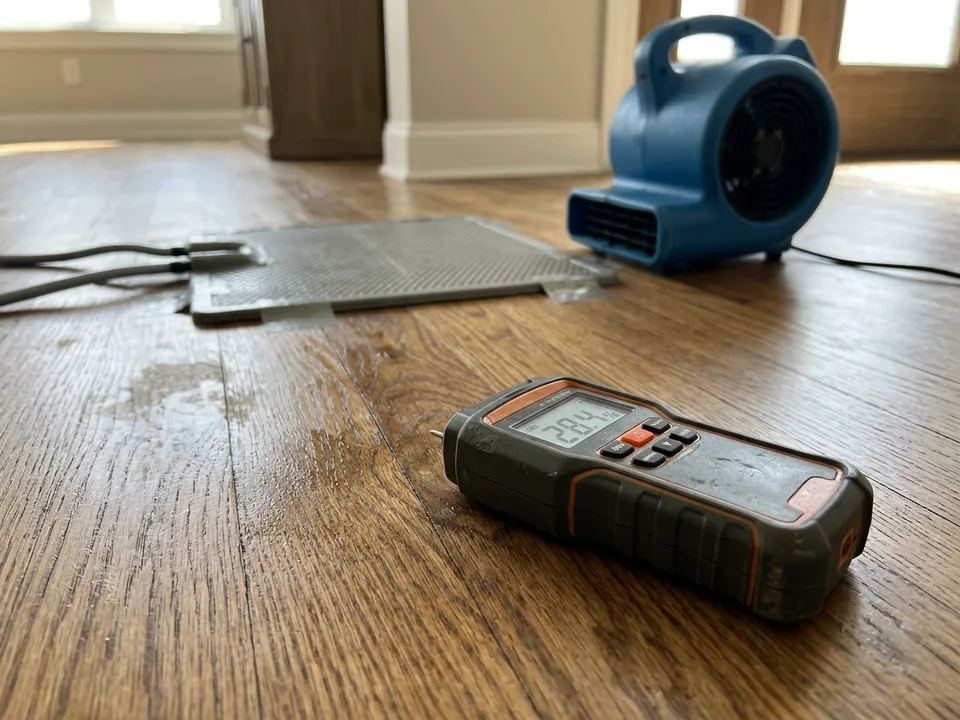
What This Restoration Service Involves
- Establishing a dry-standard baseline by measuring unaffected wood and drywall in a dry room of the same home.
- Deploying commercial Low-Grain Refrigerant (LGR) dehumidifiers sized to the cubic footage and IICRC drying class of the loss.
- Positioning high-velocity centrifugal and axial air movers to create continuous airflow across wet boundary layers.
- Specialty Class 4 drying setups—such as negative-pressure hardwood floor drying mats—when dense materials like oak or plaster are saturated.
- Daily psychrometric logs recording grain depression, relative humidity, and material moisture percentages until dry goals are met.
Common Warning Signs & Problems Addressed
- Cupping or crowning hardwood floor planks several days after a kitchen or burst pipe leak.
- Condensation forming on interior windows or a heavy, humid smell lingering after a DIY cleanup.
- Swollen door frames, sticking trim, or soft baseboards following water extraction.
- Elevated moisture readings inside basement studs or crawl space joists.
Step-by-Step Field Mitigation Process
Independent restoration crews follow ANSI/IICRC S500 drying science: evaporation without dehumidification simply pushes moisture into dry upstairs rooms. Technicians balance the number of air movers against LGR dehumidifier grain-removal capacity, seal off the drying zone with poly containment when helpful, and inspect readings every 24 hours. Most standard losses take 3 to 5 days—read our full structural drying timeline guide to see what happens each day.
Key Cost Factors in Utah County
Drying cost depends on equipment count (number of air movers, LGR dehumidifiers, HEPA air scrubbers, and specialty floor mats), total drying days, and material density (Class 1–4). Use our cost estimator to preview how drying duration affects total project range.
When to Call Immediately
Call whenever water has touched drywall, subfloor plywood, hardwood flooring, or framed walls—even if you already mopped up the visible puddle. Shutting down drying too early traps moisture inside wall cavities and leads to hidden mold and warped floors.
Frequently Asked Questions
Can I turn off the drying fans at night to sleep?
Turning off air movers and dehumidifiers overnight slows evaporation, allows moisture to equalize back into dry materials, and adds extra days to the project. Technicians can discuss containment placement to reduce noise in adjacent bedrooms.
How do technicians know when my walls are truly dry?
Instead of guessing by touch, restoration crews compare daily pin and pinless moisture-meter readings from the wet area against an unaffected dry-standard wall in your home.
Why do professionals use LGR dehumidifiers instead of retail store dehumidifiers?
Commercial LGR (Low-Grain Refrigerant) dehumidifiers continue pulling moisture out of the air even at low specific humidity, which is essential for drying dense wood studs and subfloors.