
What Is the Difference Between Water Damage Categories and Drying Classes?
Under the ANSI/IICRC S500 Standard for Professional Water Damage Restoration, Water Category (1, 2, or 3) measures how contaminated the water is, while Drying Class (1, 2, 3, or 4) measures how much water was absorbed and how difficult the wet building materials are to evaporate. Both classifications work together to determine safety gear, tear-out scope, and commercial dehumidifier sizing.
When a homeowner in Cedar Fort, Fairfield, or Eagle Mountain calls our Cedar Valley water damage restoration referral line, one of the first things the dispatched independent technician evaluates is the exact Category and Class of loss. Understanding those two scales helps you read contractor estimates clearly, ask smart questions before signing a work authorization, and avoid paying for unnecessary demolition—or worse, leaving contaminated materials behind.
How Does IICRC S500 Define Category 1, Category 2, and Category 3 Water?
Water categories evaluate both the originating source of the leak and what the water passes through once it enters your home. Clean water from a sanitary supply line does not stay clean forever: elapsed time, warm indoor temperatures, and contact with dirty subfloors or building dust can degrade a Category 1 loss into Category 2 or even Category 3.
| Category | Contamination Level | Common Utah Home Sources | Typical Salvage & Safety Rules |
|---|---|---|---|
| Category 1 (Clean) | Originates from a sanitary source; low immediate health risk if mitigated promptly. | Broken PEX/copper supply lines, ruptured tank water heaters, overflowing sinks/tubs without detergent, clean toilet supply tanks. | Fast extraction and in-place drying often save carpet, baseboards, and undamaged drywall; carpet pad is evaluated case-by-case. |
| Category 2 (Gray) | Contains significant chemical, detergent, or biological contamination that may cause illness or discomfort. | Washing machine discharge hoses, dishwasher drain leaks, toilet bowl overflows with urine (no feces), hydrostatic basement groundwater seepage. | Carpet cushion (pad) is removed and discarded; carpet may be cleaned/disinfected or removed; antimicrobial treatment applied before drying. |
| Category 3 (Black) | Grossly contaminated with pathogenic bacteria, viruses, toxins, or sewage solids; severe health hazard. | Main sewer backups, rural septic overflows, toilet backflows with feces, muddy exterior surface floodwater entering window wells. | Full containment, PPE, HEPA air scrubbers, and mandatory disposal of porous materials (carpet, pad, lower drywall, insulation) via sewage cleanup. |
Can Category 1 Clean Water Turn Into Category 2 or Category 3 Water?
Yes—clean water degrades over time and upon contact with contaminated surfaces. If a clean supply pipe bursts inside a dusty attic, flows down through fiberglass insulation, and sits stagnant in a warm basement carpet for 48 to 72 hours, microbial activity multiplies rapidly. Under IICRC S500 guidelines, technicians assess both the original water source and current job-site conditions (including odor, elapsed time, and temperature) rather than blindly assuming a supply-line leak stayed sanitary after three days.
Is Rainwater or Groundwater Always Category 3?
Not automatically, though water that travels across exterior soil, mulch, fertilizer, or pavement before entering a basement usually carries heavy contamination. Recent IICRC S500 consensus guidance clarifies that wind-driven rain entering directly through a roof or window is evaluated on actual job-site contact rather than automatically labeled Category 3—whereas muddy surface runoff pouring across an Eagle Mountain or Saratoga Springs yard and overflowing a basement window well has contacted soil bacteria and is routinely treated as Category 3.
What Are Drying Classes 1, 2, 3, and 4 in Water Restoration?
Drying Classes (1 through 4) quantify evaporation load—telling technicians how many commercial air movers and how much Low-Grain Refrigerant (LGR) dehumidification capacity are needed to dry the structure efficiently.
| Drying Class | Absorption & Evaporation Rate | Typical Structural Footprint | Equipment & Timeline Impact |
|---|---|---|---|
| Class 1 | Slowest evaporation / least moisture absorbed | Affects only part of a room or low-porosity materials (concrete, tile) with minimal wet carpet or drywall. | Minimal air movers and 1 LGR dehumidifier; often dries in 2–3 days. |
| Class 2 | Fast evaporation / large wet surface area | Affects an entire room of carpet and cushion; water has wicked up drywall less than 24 inches; structural subfloor is damp. | Full room perimeter air movers + sized LGR dehumidifier; typically 3–4 days. |
| Class 3 | Fastest evaporation / greatest saturation | Water typically came from overhead (e.g., upstairs burst pipe); ceilings, walls, insulation, carpet, and subfloor are all saturated. | Highest dehumidification capacity, selective ceiling/wall opening, and 4–5+ days of drying. |
| Class 4 | Specialty drying / bound moisture in dense materials | Low-permeance materials like solid oak hardwood, historic plaster (common near Fairfield), brick, stone, or dense concrete. | Requires very low specific humidity, Injectidry/floor mats, or desiccant/LGR setups; often 5–7+ days. |
Why Do Categories and Classes Directly Affect Your Restoration Estimate?
Category dictates safety protocols and tear-out rules, while Class dictates equipment count and drying days—together they explain why two 400-square-foot basement floods can differ in cost by thousands of dollars.
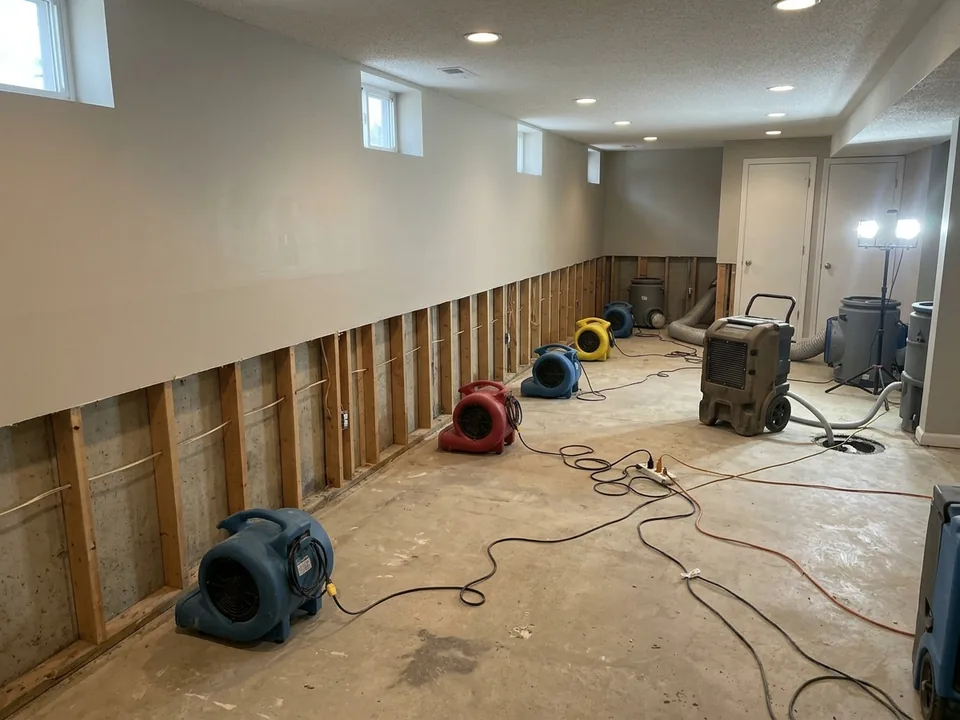
Consider two identical 400-square-foot finished basements in The Ranches or SilverLake. In Home A, a water heater supply valve splits (Category 1, Class 2). An independent restoration crew extracts the water within three hours, lifts the carpet to pull the soaked pad, detaches baseboards, and runs four air movers plus one commercial LGR dehumidifier for three days. The drywall and carpet are saved.
In Home B, a main sewer line backs up through the basement floor drain across the exact same 400 square feet (Category 3, Class 2). Because black water carries hazardous pathogens, the crew must build poly containment zippers, run a negative-air HEPA air scrubber, wear full PPE, remove and bag all contaminated carpet, pad, baseboards, and the lower 24 inches of drywall and insulation, scrub and disinfect every stud bay with EPA-registered antimicrobials, and then run structural drying equipment on the sanitized framing. Preview how those variables change ballpark Utah pricing using our water damage cost calculator.
Diagnostic Checklist: 5 Questions to Ask Your Restoration Technician About Classification
Before signing a mitigation work authorization, ask the independent technician to walk you through their exact Category and Class determination using physical readings rather than guesswork.
- "What physical evidence supports the Category 1, 2, or 3 classification?" Ask whether they evaluated the original source, elapsed hours, and materials contacted.
- "Which porous materials can be dried in place versus removed?" In Category 1 losses, unnecessary drywall tear-outs add rebuild costs; in Category 3 losses, trying to save contaminated carpet pad is a health hazard.
- "What is the dry-standard reading from an unaffected room in my house?" Reliable crews establish a baseline wood/drywall moisture reading in a dry room so you can see daily progress on the drying log.
- "Are you checking concealed cavities like crawl spaces or adjacent closets?" Water frequently travels under shared framing into crawl spaces or neighboring basement bedrooms.
- "Will I receive daily psychrometric logs and photos for my insurance adjuster?" Clear classification notes aligned with ANSI/IICRC S500 standards help adjusters approve mitigation line items faster—see our Utah insurance claim checklist for what to save.
Material-by-Material Salvageability Matrix by Water Category
Not every wet surface inside a Cedar Valley home responds the same way to contamination—porous materials absorb dissolved solids and bacteria deeply, while non-porous materials can usually be thoroughly disinfected and saved. Use this reference matrix to understand why independent restoration technicians recommend drying certain structural components in place while removing others during a Category 2 or Category 3 loss:
| Building Material | Category 1 (Clean) | Category 2 (Gray) | Category 3 (Black / Sewage) |
|---|---|---|---|
| Carpet & Rebond Pad | Carpet often salvageable; pad frequently replaced for faster drying. | Pad removed; carpet cleaned/disinfected or replaced depending on backing. | Mandatory removal and bagged disposal of both carpet and pad. |
| Gypsum Drywall & Insulation | Drywall often dried in place if uninsulated; wet fiberglass insulation removed. | Wet insulation removed; lower drywall flood-cut if wicking is extensive. | Clean 12–24 inch drywall flood cuts above waterline and full insulation removal. |
| Solid Wood Framing & Studs | Dried in place with LGR dehumidifiers and verified via pin meters. | Cleaned, treated with antimicrobial wash, and dried to dry standard. | Power-cleaned, HEPA-vacuumed, antimicrobial-sanitized, and structurally dried. |
| Ceramic Tile & Concrete Slab | Extracted and dried; grout joints checked for sub-slab moisture pockets. | Extracted, scrubbed with detergent/antimicrobial, and dried thoroughly. | Extracted, multi-stage biohazard wash and EPA-registered disinfection. |
| Laminate & Floating LVP | Laminate usually swells and fails; waterproof LVP lifted so trapped subfloor dries. | Laminate discarded; LVP lifted and sanitized only if manufacturer permits. | Full removal and disposal; subfloor thoroughly disinfected before drying. |
Notice how floating luxury vinyl plank (LVP)—extremely popular in newer Eagle Mountain, SilverLake, and Saratoga Springs basements—creates a common trap during Category 1 and Category 2 losses. Even though the vinyl wear layer itself is waterproof, liquid water slips through perimeter expansion gaps and sits pinned underneath the underlayment against cool concrete or OSB subflooring. Because vapor cannot evaporate upward through solid vinyl, leaving floating LVP locked down over wet subflooring leads to trapped odors and microbial growth even when the room looks completely dry.
Frequently Asked Questions
Is a washing machine overflow Category 1 or Category 2 water?
A clean supply hose rupture behind the washer is typically Category 1, whereas discharge water coming out of the drain hose or tub during a wash cycle contains detergents, soils, and bacteria and is classified as Category 2 (gray water).
Why is solid hardwood classified as Class 4 specialty drying?
Dense hardwood planks and subfloor assemblies have very low permeance, meaning trapped moisture moves slowly out of wood cells and requires very low specific humidity and negative-pressure floor drying mats to prevent permanent cupping.
Does Category 3 sewage damage always require removing drywall?
Yes, porous gypsum drywall and fiberglass insulation that directly absorb Category 3 black water cannot be reliably sanitized inside the paper core and are typically flood-cut 12 to 24 inches above the highest visible water line.