
How Long Does Professional Structural Drying Usually Take After a Home Flood?
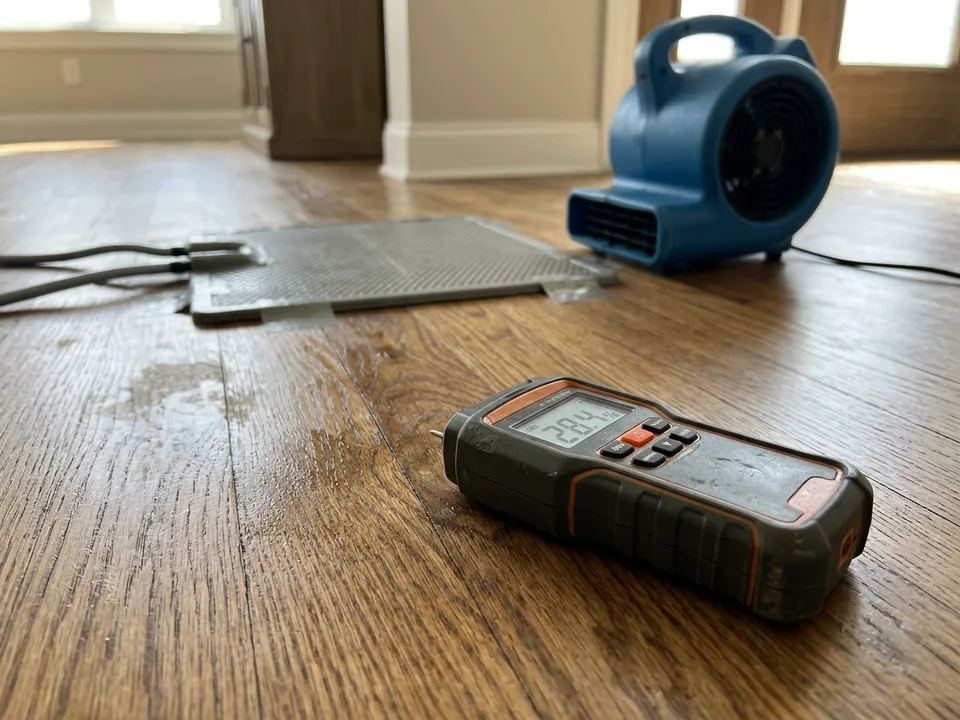
Most residential water losses dry completely in 3 to 5 days when commercial air movers and Low-Grain Refrigerant (LGR) dehumidifiers run continuously without interruption. Dense Class 4 assemblies—such as solid oak hardwood flooring, multi-layer plaster walls, or saturated concrete-backed basement framing—can extend the drying timeline to 6 or 7 days.
Homeowners across Eagle Mountain, Cedar Fort, Fairfield, and Saratoga Springs are often surprised to learn that "dry to the touch" is not the same as structurally dry. Drywall paint and carpet fibers release surface moisture quickly within the first 24 hours, while bound water inside wooden sill plates, OSB subflooring, and gypsum cores can remain above 20% moisture content for days—high enough to trigger hidden mold and wood decay if equipment is pulled too early.
What Happens Day by Day During a 3-to-5-Day Structural Dry-Out?
Professional structural drying and dehumidification follows a measured daily progression verified by calibrated pin meters, pinless meters, and digital hygrometers—never guesswork.
| Drying Stage | Primary Field Activity | What Technicians Measure | What Homeowners Notice |
|---|---|---|---|
| Day 1 (Stabilization) | Bulk water extraction, carpet pad removal if needed, baseboard detachment, initial equipment placement. | Baseline "dry standard" in an unaffected room, initial wet material readings, outdoor vs. indoor temperature & relative humidity. | Loudest day; standing water disappears quickly; warm, dry air begins circulating across wet walls. |
| Day 2 (Peak Evaporation) | Daily monitoring visit; adjusting air-mover angles; checking dehumidifier condensate drain lines and grain depression. | Drops in surface moisture; checking whether vapor barriers or wet insulation are stalling cavity evaporation. | Floors feel dry to the touch, though meters still show elevated moisture inside sill plates and studs. |
| Day 3 (Deep Bound Moisture) | Repositioning air movers toward remaining "hot spots" (corners, exterior foundation walls, subfloor seams). | Wood framing moisture trending toward 10–14% equilibrium; indoor specific humidity staying tightly controlled. | Noticeably less musty odor; technicians may pull select fans from already-dry rooms. |
| Days 4–5 (Verification & Breakdown) | Final moisture-map confirmation against dry standards; equipment takedown and final drying log delivery. | Every monitored drywall, stud, and subfloor point within acceptable variance of the home's dry standard. | Quiet restored; structure is verified dry and ready for any needed drywall, baseboard, or flooring repairs. |
Why Does Utah's Dry Desert Climate Still Require Commercial Dehumidifiers?
Even though Cedar Valley's outdoor air is semi-arid, flooding an enclosed basement or crawl space creates an indoor microclimate where relative humidity spikes past 70% to 90% within hours. Opening windows in winter brings sub-freezing air that actually slows evaporation and risks secondary pipe freezes, while opening windows during summer monsoon weeks or high-wind dust storms introduces outdoor contaminants and uncontrolled humidity swings.
Commercial LGR (Low-Grain Refrigerant) dehumidifiers—such as units engineered by Dri-Eaz and Phoenix Restoration—work inside a closed drying chamber. Unlike retail big-box dehumidifiers that lose efficiency once indoor relative humidity drops below 50%, LGR units double-cool incoming air before it hits the evaporator coils, continuing to pull pints of moisture per hour down to very low grains per pound (GPP). That deep grain depression creates the vapor-pressure differential required to draw bound water out of dense wooden studs and concrete-backed basement framing.
5 Factors That Extend (or Shorten) Your Drying Timeline
No two water losses dry at the exact same speed because evaporation depends on extraction thoroughness, material permeability, temperature, airflow, and uninterrupted runtime.
- Speed & Quality of Initial Extraction: Removing liquid water mechanically with truck-mounted extractors is hundreds of times faster than evaporating it into the air. Thorough Day 1 extraction routinely shaves 24 to 48 hours off total drying time.
- Material Density & Assembly Layers: Bare concrete and single-layer drywall dry rapidly. Double-layered fire-rated drywall in attached townhomes (common in SilverLake), vapor-retarding vinyl wallpaper, laminated cabinetry, and solid oak flooring in The Ranches require specialized cavity injection or negative-pressure floor mats.
- Basement Temperature: Cool 58°F unfinished basements evaporate moisture much slower than 72°F main-level living rooms. Maintaining steady indoor temperatures around 70°F to 75°F accelerates vapor release safely.
- Trapped Wet Insulation: Saturated fiberglass batt insulation inside framed walls or crawl spaces holds water like a wet sponge against wooden framing and almost never dries cleanly without removal.
- Turning Equipment Off Overnight: Shutting off air movers and dehumidifiers for 8 hours every night lets moisture migrate back into partially dried wood and drywall, frequently stretching a 3-day dry-out into a 6-day project and raising mold risk.
How Restoration Technicians Verify Your Home Is Actually Dry
Reliable restoration crews never rely on "the hand test" or visual dryness—they document quantitative readings across four distinct instruments every 24 hours.
- Non-Invasive Pinless Moisture Meters: Emit an electromagnetic signal roughly 3/4-inch into drywall, tile, or hardwood without leaving pinholes, letting crews quickly map the wet perimeter.
- Penetrating Pin Moisture Meters: Measure electrical resistance directly inside wood framing studs, bottom sill plates, and subfloor plywood to give an exact percent moisture content (%MC).
- Infrared Thermal Imaging Cameras: Highlight cool evaporative zones behind ceilings and exterior walls—especially vital after an overhead burst pipe.
- Digital Thermo-Hygrometers: Track temperature, relative humidity, and grains per pound (GPP) in the affected chamber, unaffected living area, dehumidifier exhaust, and outdoor air to confirm the dehumidifier is actively removing water.
When you connect with an independent local contractor through our Cedar Valley water damage restoration referral line, ask to see your daily drying log before equipment is removed. Those logs also serve as crucial proof for your insurance adjuster if you are filing a claim—learn more in our Utah insurance documentation guide and check how drying duration impacts ballpark budgets on our cost calculator.
Practical Tips for Living Through a 3-to-5-Day Dry-Out
Small adjustments during drying week keep your household comfortable while protecting your drying schedule from costly setbacks. Keep interior doors to the drying zone closed (or poly containment zippers sealed) so LGR dehumidifiers do not waste energy conditioning the entire house. Expect a slight bump in electricity usage while commercial fans run—note that many homeowners insurance policies reimburse documented mitigation utility increases when submitted with your restoration logs. Finally, avoid unplugging a dehumidifier to vacuum or charge devices; if a breaker trips, call your restoration technician promptly so they can rebalance circuits safely.
Psychrometric Drying Targets: Understanding Relative Humidity vs. Specific Humidity (GPP)
Restoration crews track Grains Per Pound (GPP)—the actual weight of water vapor in one pound of dry air—because relative humidity alone changes every time room temperature rises or falls.
To understand why commercial LGR dehumidifiers outperform portable fans, consider basic psychrometrics inside a 70°F basement in Cedar Fort or Eagle Mountain. One pound of water equals 7,000 grains. During active drying, technicians aim to push the drying chamber down below 45 to 55 GPP (and often below 35 to 40 GPP for Class 4 solid hardwood floors in The Ranches). When the air surrounding a damp oak plank or pine framing stud holds far less moisture than the wet wood cells, vapor pressure naturally forces bound moisture outward from the core of the wood into the dry airstream, where the LGR dehumidifier condenses it into liquid and pumps it directly into a utility sink or floor drain.
| Material Type | Typical Dry Standard (%MC) | Elevated / Wet Threshold | Primary Drying Strategy |
|---|---|---|---|
| Framing Lumber (Pine/Fir Studs) | 8% – 12% in Utah | 16% or higher (mold risk rises above 16–20%) | Open airflow across bottom sill plates + balanced LGR dehumidification |
| OSB / Plywood Subflooring | 8% – 12% | 15% or higher | Lift pad or floating floor; dry from top and beneath (via crawl space or open joists) |
| Solid Oak / Maple Hardwood | 6% – 9% in Utah | More than 2–4% above unaffected planks | Negative-pressure floor drying mats + low-GPP dehumidifier exhaust |
| Gypsum Drywall (Relative Scale) | Baseline dry wall reading | Noticeably elevated above dry room reference | Baseboard removal, weep holes, or 24-inch flood cuts if insulated |
Because Cedar Valley sits at roughly 4,600 to 5,100 feet elevation with naturally dry baseline building materials, local framing lumber often starts around 8% to 10% moisture content—lower than coastal states. That is why establishing a dry standard inside an unaffected room of your own house is far more accurate than relying on generic national averages. When independent technicians monitor your basement flood cleanup or crawl space water removal daily, they keep equipment running only until every structural target matches your home's true dry baseline.
Frequently Asked Questions
How much electricity do commercial drying fans and dehumidifiers use?
A typical residential setup of four to six air movers and one LGR dehumidifier draws roughly 15 to 25 amps total—similar to running a central air conditioner—usually adding a modest amount to that month's utility bill over 3 to 5 days.
Why does the drying room feel warm while dehumidifiers are running?
LGR dehumidifiers release heat of condensation as they convert water vapor back into liquid drained down a hose. Warm, dry air actually speeds up structural evaporation.
What happens if I ask the crew to remove equipment on Day 2 because the floor feels dry?
Pulling equipment before hidden studs and subfloor seams reach dry standards traps bound moisture inside walls, risking delayed hardwood cupping, peeling paint, and mold growth inside 48 hours.